library(mvtnorm)
library(ggplot2)
library(dplyr)

overall_opchar<-function(marg_alpha = NULL, marg_power = NULL, r, co = TRUE) {

  if (is.null(marg_alpha) && is.null(marg_power)) {
    stop("At least one of marg_alpha and marg_power must be given.")
  }

  totalpha <- NULL
  totpower <- NULL

  if (!is.null(marg_alpha)) {

    if (length(marg_alpha)<2) {
      stop("marg_alpha has to be of length 2 or larger")
    }

    z<-qnorm(1 - marg_alpha)

    totalpha <- unlist(lapply(r, function(x) {
      sigma <- matrix(x, length(marg_alpha), length(marg_alpha))
      diag(sigma) <- 1

      if (co) {
         # All endpoints must be significant
        return(pmvnorm(lower = z, corr = sigma))
      } else {
         # One endpoint must be significant
        return(1 - pmvnorm(upper = z, corr = sigma))
      }
    }))
   }

  if (!is.null(marg_power)) {

    if (length(marg_power)<2) {
      stop("marg_power has to be of length 2 or larger")
     }

    #use any alpha if not given, power does not depend on it.
    if (is.null(marg_alpha)) {
      marg_alpha<-rep(0.05,length(marg_power))
      z<-qnorm(1 - marg_alpha)
    }

    omega<-z + qnorm(marg_power)

     totpower <- unlist(lapply(r, function(x) {
      sigma <- matrix(x, length(marg_power), length(marg_power))
      diag(sigma) <- 1

      if (co) {
        # All endpoints achieve power
        return(pmvnorm(lower = z, mean = omega, corr = sigma))
      } else {
        # At least one endpoint achieves power
        return(1 - pmvnorm(upper = z, mean = omega, corr = sigma))
      }
    }))
  }

  if (!is.null(totalpha) && !is.null(totpower)) {
    res <- data.frame(totalpha = totalpha, totpower = totpower)
  } else if (!is.null(totalpha)) {
    res <- data.frame(totalpha = totalpha)
  } else {
    res <- data.frame(totpower = totpower)
  }
  res<-cbind(r,res)
  row.names(res)<-NULL
  return(res)
}Error Rates for Multiple Endpoints
The FDA guidance on multiple endpoints in clinical trials lists four types of multiple endpoints:
- Co-primary endpoints: When demonstration of treatment effects on two or more distinct endpoints is recommended to establish clinical benefit
- Several primary endpoints: When demonstration of a treatment effect on at least one of several primary endpoints is sufficient
- Composite endpoints
- Multi-component endpoints
The former two have some consequences on overall family-wise type I and II error rates, we will discuss here. In both situations, the overall error rates can be calculated form the individual, marginal error rates using a multivariate normal distribution:
Co-primary endpoints
Multiple primary endpoints become co-primary endpoints when demonstrating an effect on each of the endpoints is required for a positive trial.
With co-primary endpoints, there is no multiplicity problem because the overall, family-wise type I error rate (FWER) is strictly controlled at the maximum of the marginal alphas. However, co-primary endpoint testing increases the type II error rate (and reduces power) because there is more than one opportunity to make a type II error.
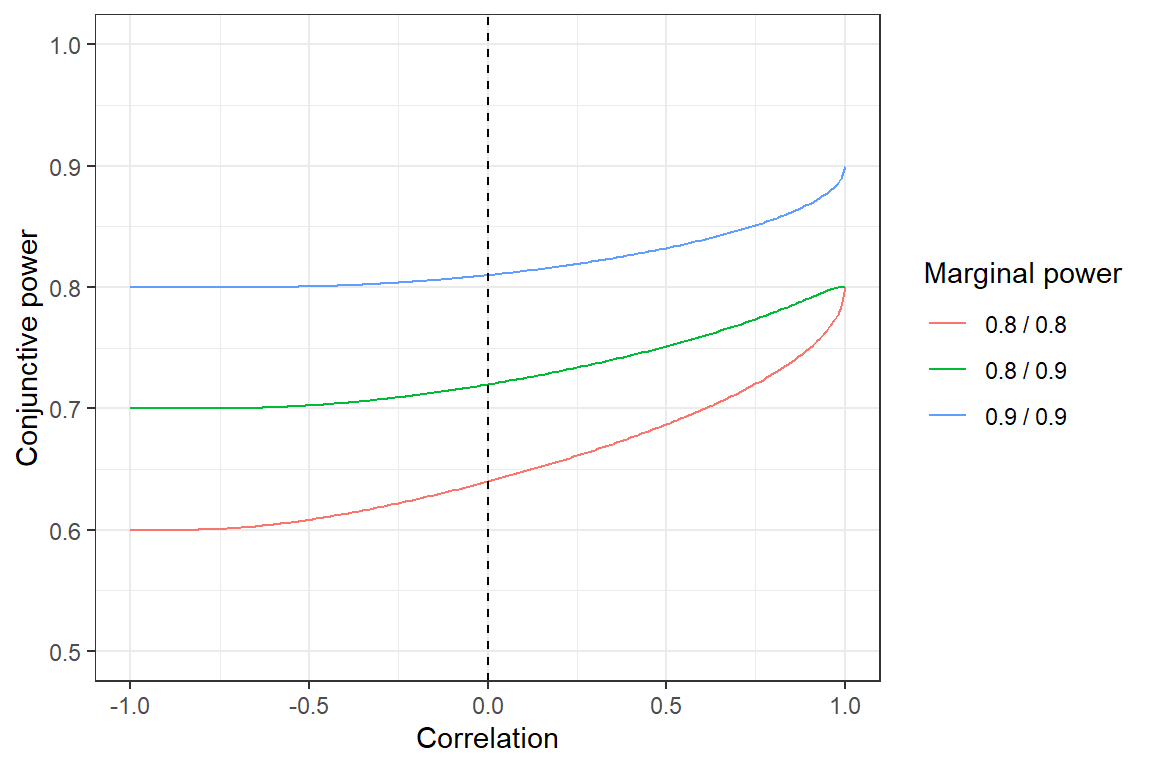
For co-primary endpoints, we need to control the conjunctive power, i.e. the probability of rejecting all null hypotheses simultaneously.
We can distinguish these three scenarios:
- Assuming independence, FWER and conjunctive power are the product of the individual, marginal alphas and powers, respectively. The overall is then smaller then the individual ones, which is conservative for the type I error but results in a loss of power.
- With a positive correlation (which often is the most likely scenario), FWER and conjunctive power are increasing up to the minimum of the marginal ones when there is a perfect positive correlation (r=1).
- With a negative correlation, FWER and conjunctive power are decreasing up to the sum of the marginals -1 (or 0 if negative) when there is a perfect negative correlation (r=-1).
Overall,
- the FWER is is bounded above by the minimum of the marginals, and
- the conjunctive power is bounded below by the sum of the marginals - 1 (capped at 0, the Fréchet bound) or the product of the marginal if negative correlations can be excluded.
For example, with the conventional marginal alpha of 0.05 and marginal power of 0.8, the upper boundary of the FWER is 0.05, the lower boundary of the power 0.6:
overall_opchar(marg_alpha = c(0.05,0.05), marg_power = c(0.8,0.8),
  r = c(-1,0,1), co = TRUE)
r totalpha totpower
1 -1 0.0000 0.60
2 0 0.0025 0.64
3 1 0.0500 0.80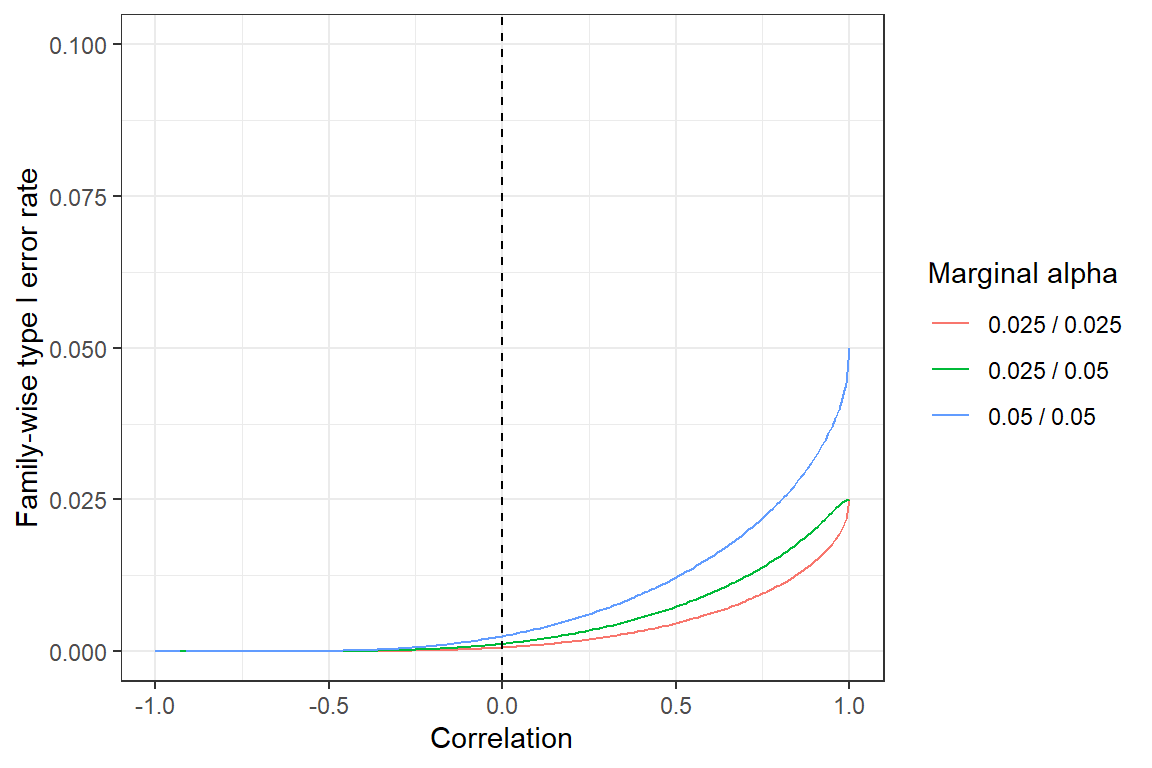
Several primary endpoints
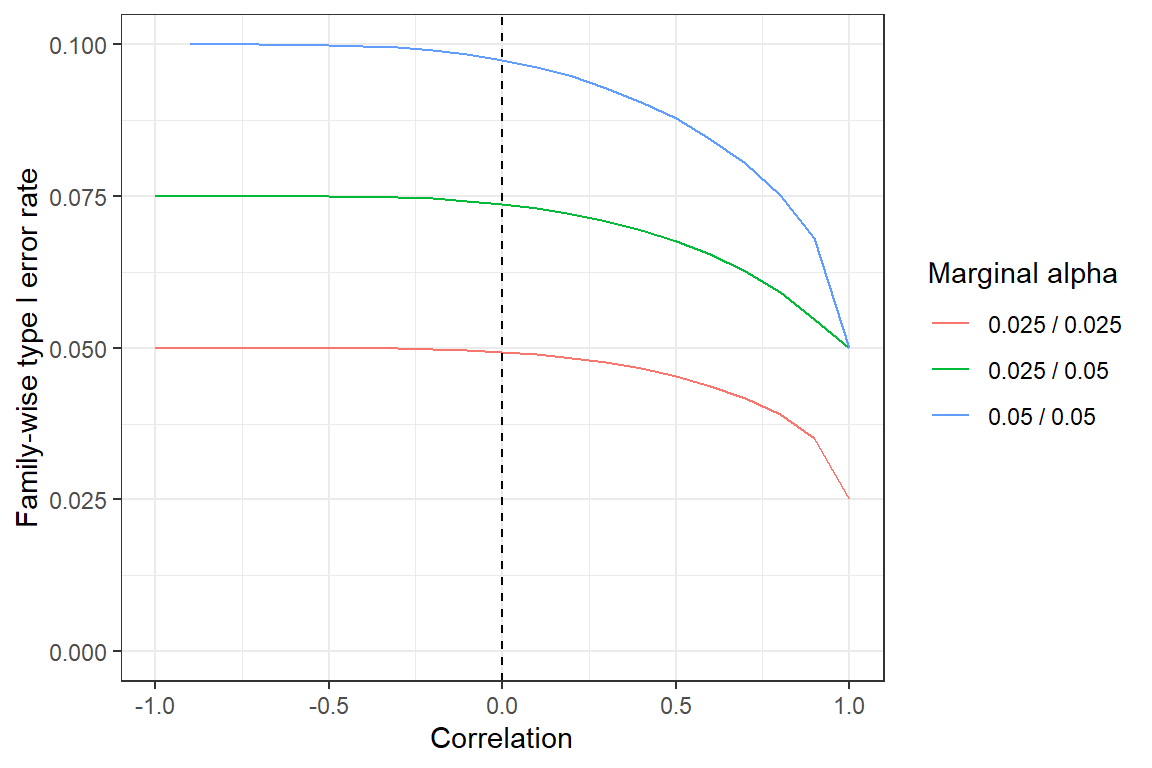
A study might be designed such that success on any one of several endpoints could support a conclusion of effectiveness. This creates a primary endpoint family.
This use of several endpoints creates a multiplicity problem because there are several ways to make a type I error, and control of the family-wise type I error rate (FWER) is critical.
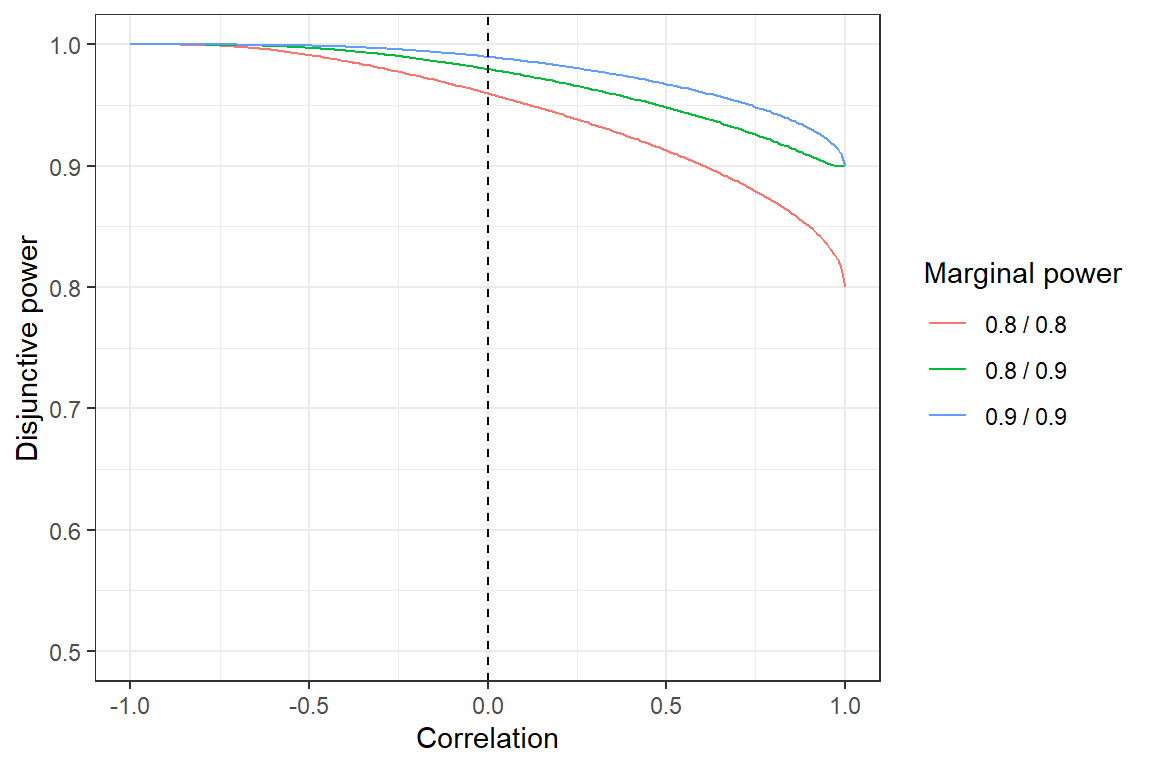
With several primary endpoints, we need to control the disjunctive power, i.e. the probability rejecting at least one null hypothesis when all alternative hypotheses are true.
We can distinguish these three scenarios:
- Assuming independence, the FWER and the disjunctive power are given by the sum minus the product of the corresponding marginal alphas and powers, respectively. The overall is then larger then the individual ones, which is anti-conservative for the type I error and a gain of power.
- With a positive correlation (which often is the most likely scenario), FWER and disjunctive power are decreasing to the maximum of the marginal ones when there is a perfect positive correlation (r=1)
- With a negative correlation, FWER and disjunctive power are increasing up to the sum of the marginals (or 1 if > 1) when there is a perfect negative correlation (r=-1).
Overall,
- the FWER is bounded above by the sum of the marginal alphas (capped at 1), and
- the disjunctive power is bounded below by the maximum of the marginal powers.
For example, With the conventional marginal alpha of 0.05 and marginal power of 0.8, the upper boundary of the FWER is 0.1, the lower boundary of the disjunctive power 0.8:
overall_opchar(marg_alpha=c(0.05,0.05), marg_power=c(0.8,0.8),
  r=c(-1,0,1), co=FALSE)
r totalpha totpower
1 -1 0.1000 1.00
2 0 0.0975 0.96
3 1 0.0500 0.80